
Rail Transit Tunnel Coverage
A tunnel is a closed metal-and-concrete space where radio does not propagate on its own. The standard solution is a leaky coaxial cable along the tunnel wall: slots in the outer conductor radiate the signal evenly along the run, and bi-directional amplifiers with section joints keep coverage continuous. For metro work, flame-retardant, low-smoke, zero-halogen jackets are mandatory — that requirement usually filters suppliers before attenuation is even discussed.
How the link is put together
A base station or repeater injects the signal, usually from one end at the station.
Laid continuously along the tunnel wall with the slots facing the track, so radiation follows the coverage area.
A joint or bi-directional amplifier every 500–800 m compensates cable loss along the run.
A matched load at the far end prevents reflections from spoiling VSWR across the section.
What to specify
Fill these in and any supplier can quote the same basis — which is exactly why we publish them.
| Impedance | 50Ω |
|---|---|
| Coupling loss | 65–75 dB for 1/2" coupled type, depending on band and distance |
| Frequency range | 800–2700 MHz, covering private, public and 5G bands |
| Jacket | LSZH flame retardant, optional rodent and termite protection |
| Installation height | 2.5–3.5 m above rail level, 150–300 mm off the wall |
| Joint protection | N-type with heat-shrink and mastic tape, IP67 |
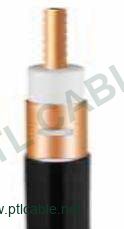
HLCAY(R)-50-12 Radiating Cable (1/2")
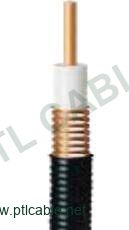
HLCAY(Z)-50-12 Leaky Feeder Cable (Coupling, 1/2")
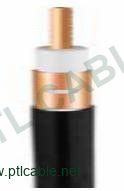
HLCTY(R)-50-22 Radiating Cable (7/8")
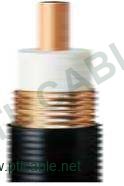
HLCTY(Z)-50-22 Leaky Feeder Cable (Coupling, 7/8")
Questions we get asked
How is leaky cable different from ordinary coaxial cable?
The outer conductor carries periodic slots that radiate part of the energy along the run, so it works as a transmission line and an antenna at once. Ordinary coax aims for zero leakage; leaky cable aims for controlled, even leakage, with slot spacing and angle setting the coupling loss.
How long can a tunnel run before a repeater is needed?
It depends on coupling loss, band and the minimum edge field strength — typically a bi-directional amplifier every 500–800 m. The layout has to come out of a link budget; give us the tunnel length, cross-section and target bands and we will propose the sections.
Does the jacket meet metro fire requirements?
LSZH flame-retardant jackets are available, with smoke density and acid gas data supplied against project requirements. Metro projects usually also ask for rodent and termite resistance, which can be built into the compound.
Need a quotation?
Send us your specification and we will reply within one working day.